
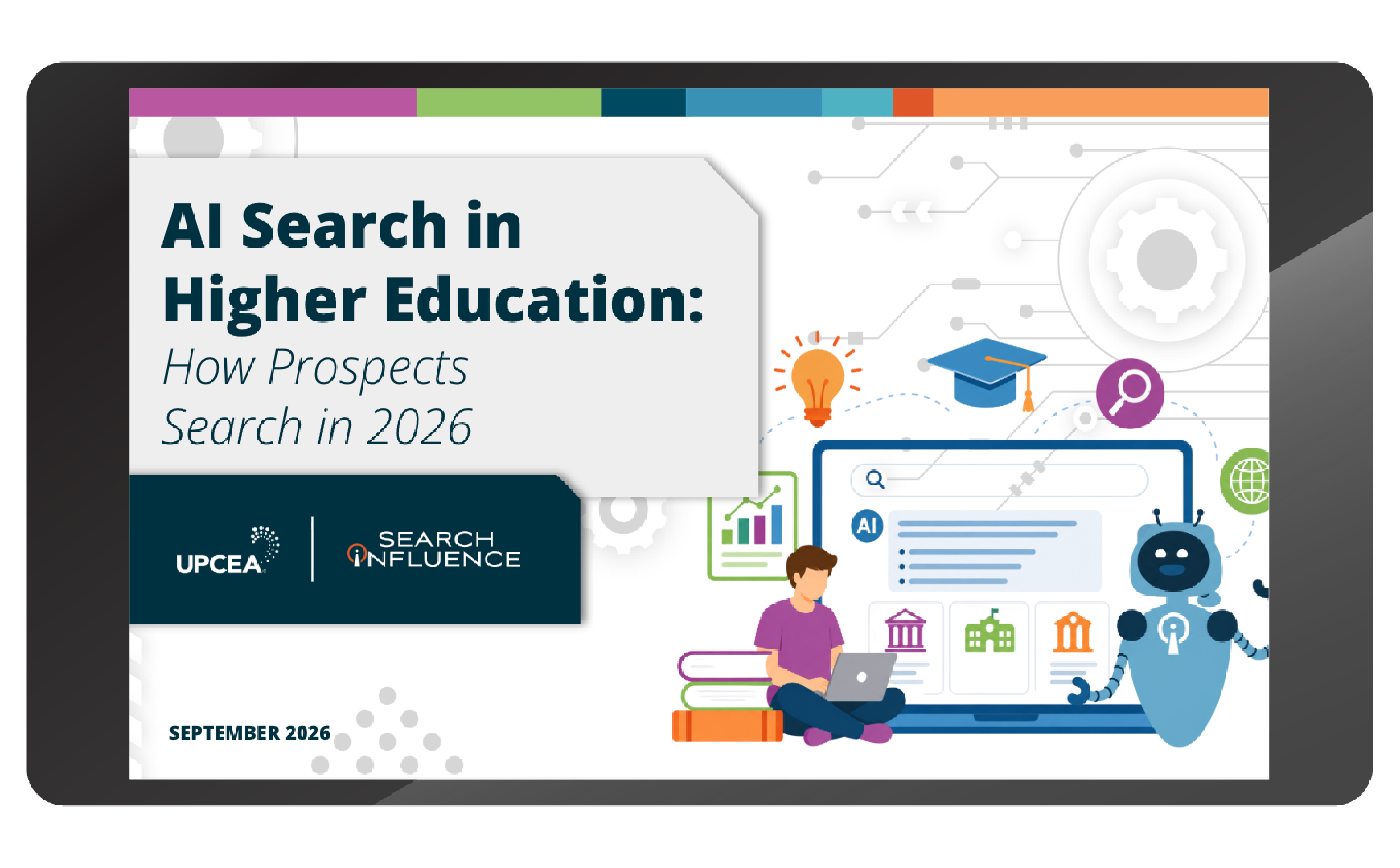
How Prospects Search in 2026
This year’s update to How Prospects Search tracks how prospective students use AI tools, search engines, and social platforms to research programs. The data reveals how rapidly search behavior is changing, and what it means for enrollment marketing.
Download the Research Study
Prospects are researching your programs across more channels than ever, using search engines, AI tools, and social platforms to build their shortlist. When your program isn’t part of that conversation, prospects never get to your website, your program pages, or your value.
Institutions that earn visibility now will be the ones prospects actually consider. The ones that wait won’t know they were never in the running.
What’s changed in how prospects search, compare, and choose programs since last year’s study
How AI users specifically put AI to work: researching options, discovering new programs, and narrowing their shortlist
Why earning a spot in AI Overviews is now as critical as ranking on page one
Download the study to find out where prospects are searching and what it takes to be found.
of prospects use AI search daily, up from 24% in 2025.
use AI to determine the best program for their goals.
trust websites more when AI cites them.
treat AI like a search engine, up from 50% in 2025.
use search engines to research programs; 54% use dedicated AI-powered search tools.
consider three or fewer programs before applying.
How Prospects Search in 2026 FAQs
What is How Prospects Search in 2026?
How Prospects Search in 2026 is the second year of a joint research study from UPCEA and Search Influence exploring how prospective students research professional and continuing education (PCE) programs. It tracks the platforms prospects use (search engines, social, and AI tools) and what drives trust and consideration as they narrow down their options. The 2026 edition builds on last year’s findability-focused study, shifting to a sharper question: not just whether AI can find an institution, but whether AI includes it on the shortlist prospects actually consider.
Who conducted the research, and who responded?
UPCEA, the leading association for professional and online education, conducted the research with support from Search Influence. Respondents were 1,057 qualified adult learners, aged 18-60, interested in professional and continuing education programs, giving the data a direct line into the population most higher ed marketers are trying to reach.
How many prospective students are using AI to research programs?
AI-powered search is growing fast. 39% of prospects now use AI tools daily to search for information, up from 24% in 2025, and the share who never use AI-powered search dropped from 17% to 12%. Beyond frequency, the way prospects use AI is shifting too: 58% now use AI-powered tools the same way they’d use a traditional search engine, up from 50% last year. Traditional search still leads overall, with 80% of prospects likely to use search engines for program research versus 54% likely to use AI tools, but the two are converging, not competing.
What is generative engine optimization (GEO), and how does it apply to higher ed?
GEO is the practice of structuring content so AI-powered search tools cite it directly in their answers, rather than just ranking it in a list of links. For higher ed, that means program pages, FAQs, and other resources need to be clear, well-structured, and credible enough for AI tools to pull from when a prospect asks about programs like yours. It’s an extension of traditional SEO, not a replacement for it. Institutions need both to stay visible across how prospects actually search.
Does being cited in AI Overviews actually drive traffic and trust?
Yes, and the data shows it does both. 83% of prospects report reading AI-generated overviews, and 59% of those click through to the sources cited within them, meaning inclusion is a direct path to your site. It also builds credibility: 64% of prospects say being cited in an AI Overview increases their trust in that website, up from 56% in 2025. For institutions, that makes AI citations worth tracking with the same discipline as search rankings.
How does AI factor into the programs prospects actually consider?
AI is playing an increasingly active role in narrowing the field. Among prospects likely to use AI for program research, 56% use it to dig deeper into programs they’re already interested in, half use it to discover new programs they hadn’t considered, and half use it to narrow their options down. That matters because the field they’re narrowing is small to begin with. Most prospective students seriously consider three or fewer programs before applying. If AI is shaping that shortlist and your program isn’t part of the conversation, it’s effectively invisible to a majority of prospects.
What can higher ed marketers do to stay visible throughout the student search journey?
Higher ed marketers need to show up everywhere prospects actually search, not just in one channel. That means optimizing for traditional search engines, AI tools, and social platforms at the same time, since prospects move between all three during the same research session. Build authoritative, well-structured content that ranks well and is easy for AI to cite, keep program information accurate and current, and track visibility across search rankings, AI citations, and social engagement alike.
About How Prospects Search in 2026
How Prospects Search in 2026 updates last year’s study from UPCEA and Search Influence, AI Search in Higher Education: How Prospects Search in 2025, which tracked how prospective students use AI tools, search engines, and social platforms to research programs. This year’s data shows how rapidly search behavior is changing and the implications for enrollment marketing.
About Search Influence
Search Influence is a woman-owned, ROI-focused digital marketing agency that helps higher education institutions drive prospects into and through the recruitment funnel with analytics-backed strategies. Our work includes SEO, AI search optimization, and paid digital advertising.
About UPCEA
UPCEA is the online and professional education association. Our members continuously reinvent higher education, positively impacting millions of lives. We proudly lead and support them through cutting-edge research, professional development, networking and mentorship, conferences and seminars, and stakeholder advocacy.